Modern Code Governance
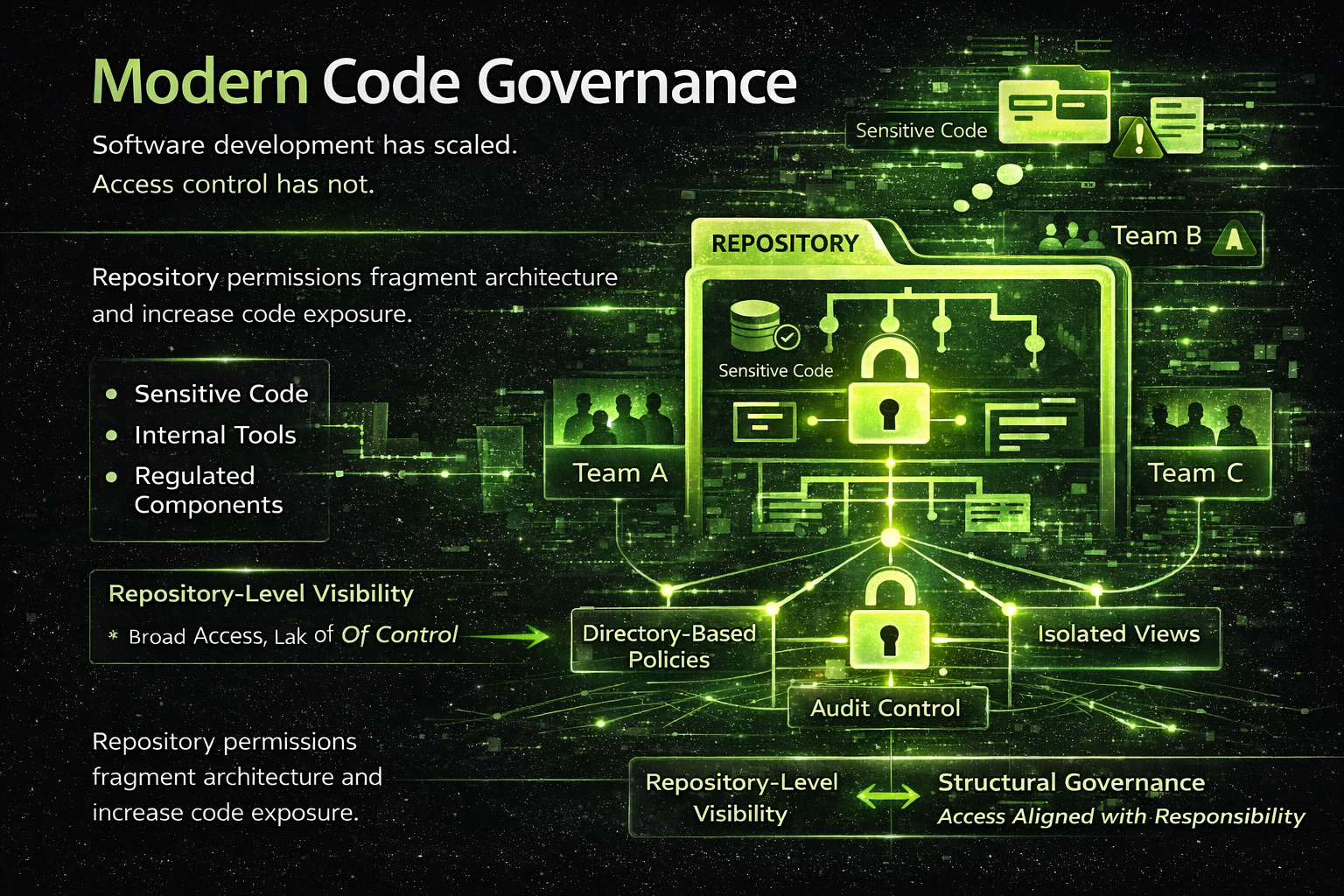
Modern Code Governance Software development has scaled. Access control has not. Engineering teams today operate in monorepos, shared service architectures, and multi-team environments. Collaboration is faster than ever. …

Feb 22, 2026 · Shawki Aladdin · Monorepo Security · 6 min read
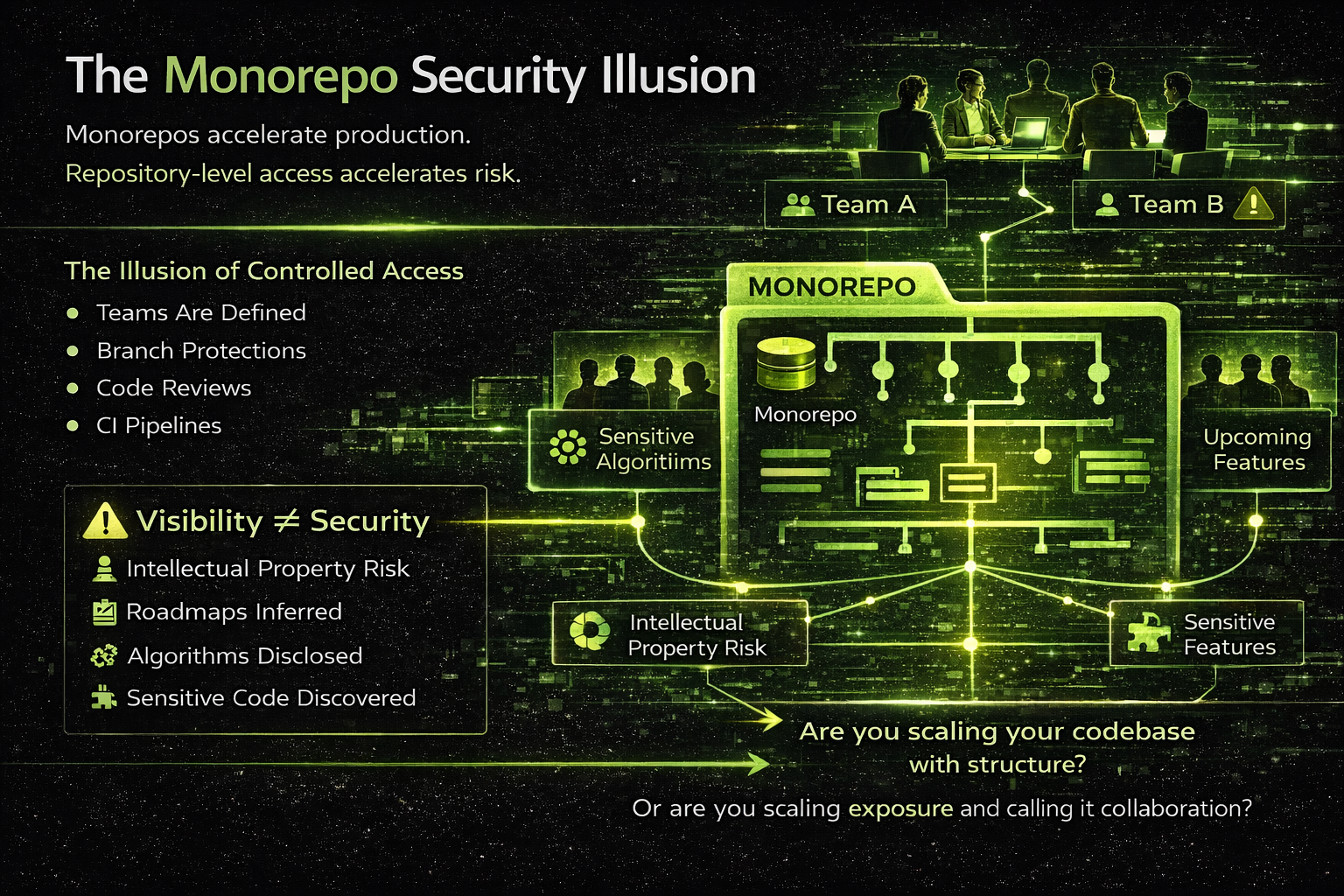
Monorepos are often praised as the ultimate engineering accelerator.
One repository.
Shared libraries.
Atomic commits.
Cross-team refactoring.
From a productivity standpoint, it makes sense.
From a security standpoint, it creates an illusion.
Many organizations assume their codebase is controlled because:
Teams are defined in Git hosting platforms
Branch protections are enabled
Pull requests require reviews
CI pipelines enforce quality gates
All of that protects changes.
Very little of it restricts visibility.
In most setups, once a user has access to the repository, they can view the entire tree.
Sensitive modules.
Internal tooling.
Upcoming features.
Regulated components.
The control exists at the change level, not at the visibility level.
That distinction matters.
Access to read is often treated as harmless.
It is not.
Visibility creates exposure:
Intellectual property can be browsed
Roadmaps can be inferred
Algorithms can be studied
Sensitive integrations become discoverable
Even without malicious intent, exposure increases risk.
And in regulated environments, broad visibility can conflict with compliance expectations.
The illusion persists because:
Splitting repositories increases complexity
Submodules introduce friction
Internal tooling becomes technical debt
Developers prefer simplicity
So organizations accept overexposure as a trade-off for collaboration.
Over time, that trade-off becomes structural.
In a 10-person team, broad visibility may not be concerning.
In a 300-person engineering organization with contractors and partners, it becomes a multiplier.
Each new user increases the exposure surface of the entire codebase.
Risk scales automatically with headcount.
Governance does not.
True monorepo security is not about restricting contribution.
It is about aligning visibility with responsibility.
That requires:
Directory-aware access boundaries
Policy-driven visibility
Isolated views per team
Auditable enforcement
Collaboration should remain frictionless.
Exposure should not.
Monorepos are not inherently insecure.
Repository-level visibility is.
The real question for modern engineering leaders is simple:
Are you scaling your codebase with structure?
Or are you scaling exposure and calling it collaboration?
Security at scale begins with recognizing the illusion — and replacing it with governance by design.
Modern Code Governance Software development has scaled. Access control has not. Engineering teams today operate in monorepos, shared service architectures, and multi-team environments. Collaboration is faster than ever. …
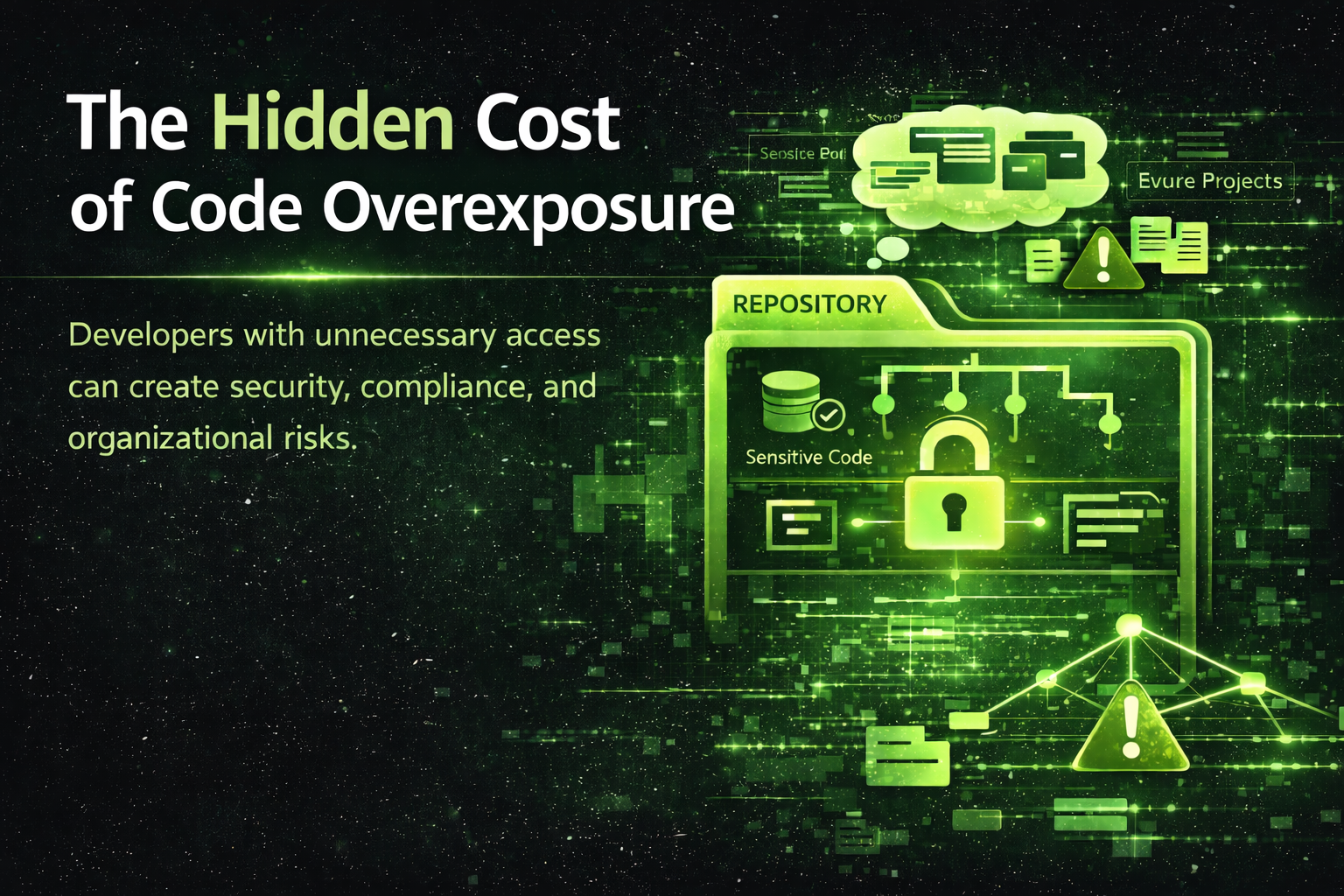
Most engineering leaders worry about external threats. Very few worry about internal overexposure. Yet in many growing organizations, dozens or hundreds of developers have visibility into parts of the codebase they do not need to see. Not because of bad intent. Not because of poor discipline. But because of how repository permissions work. And that creates a silent cost.
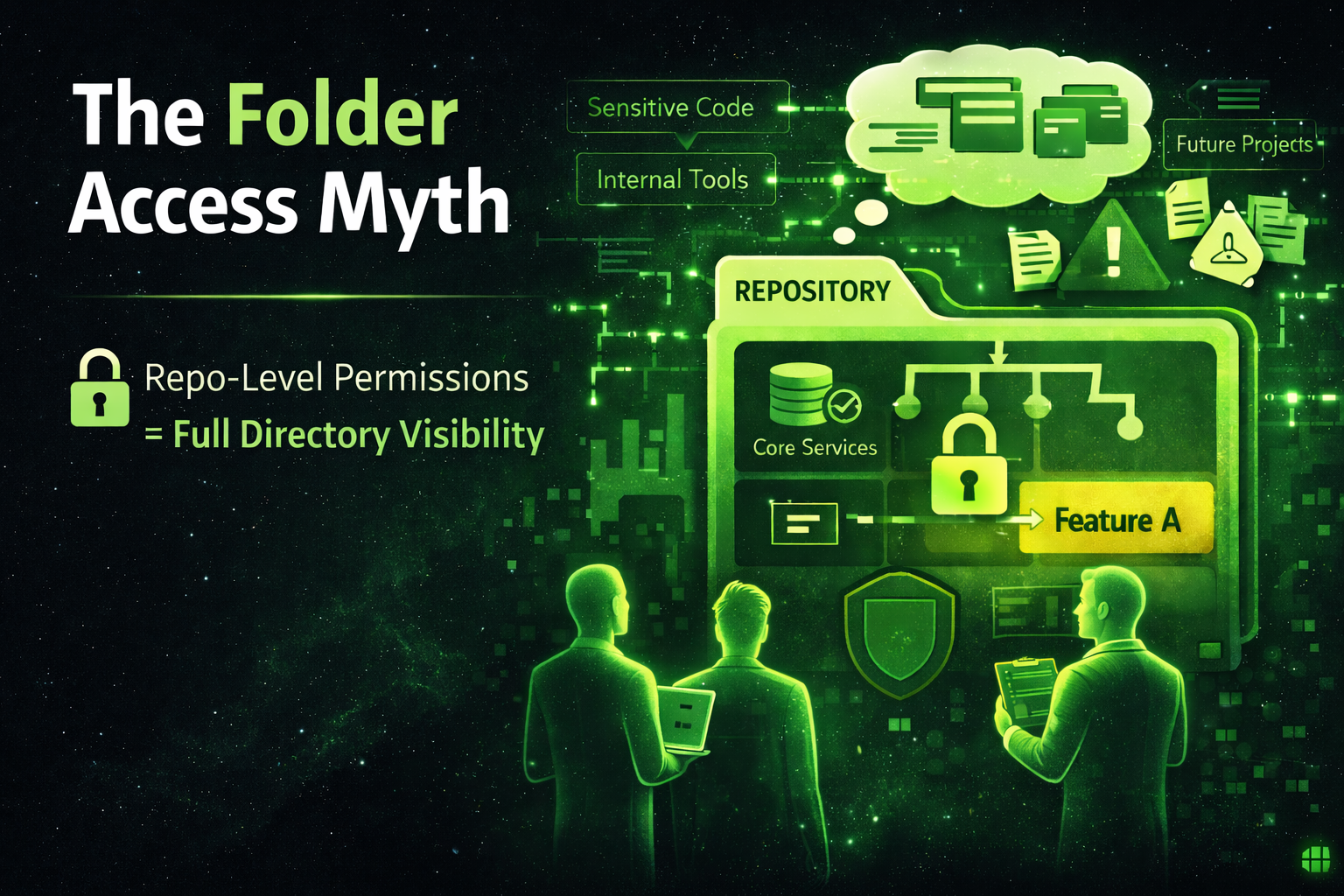
Most engineering teams assume something that is not actually true. They believe they can restrict access to specific folders inside a repository. In practice, they cannot. On platforms like GitHub and GitLab, permissions are granted at the repository level. If a user can access the repository, they can see the entire directory tree. That works fine for small teams. It breaks down in monorepos.
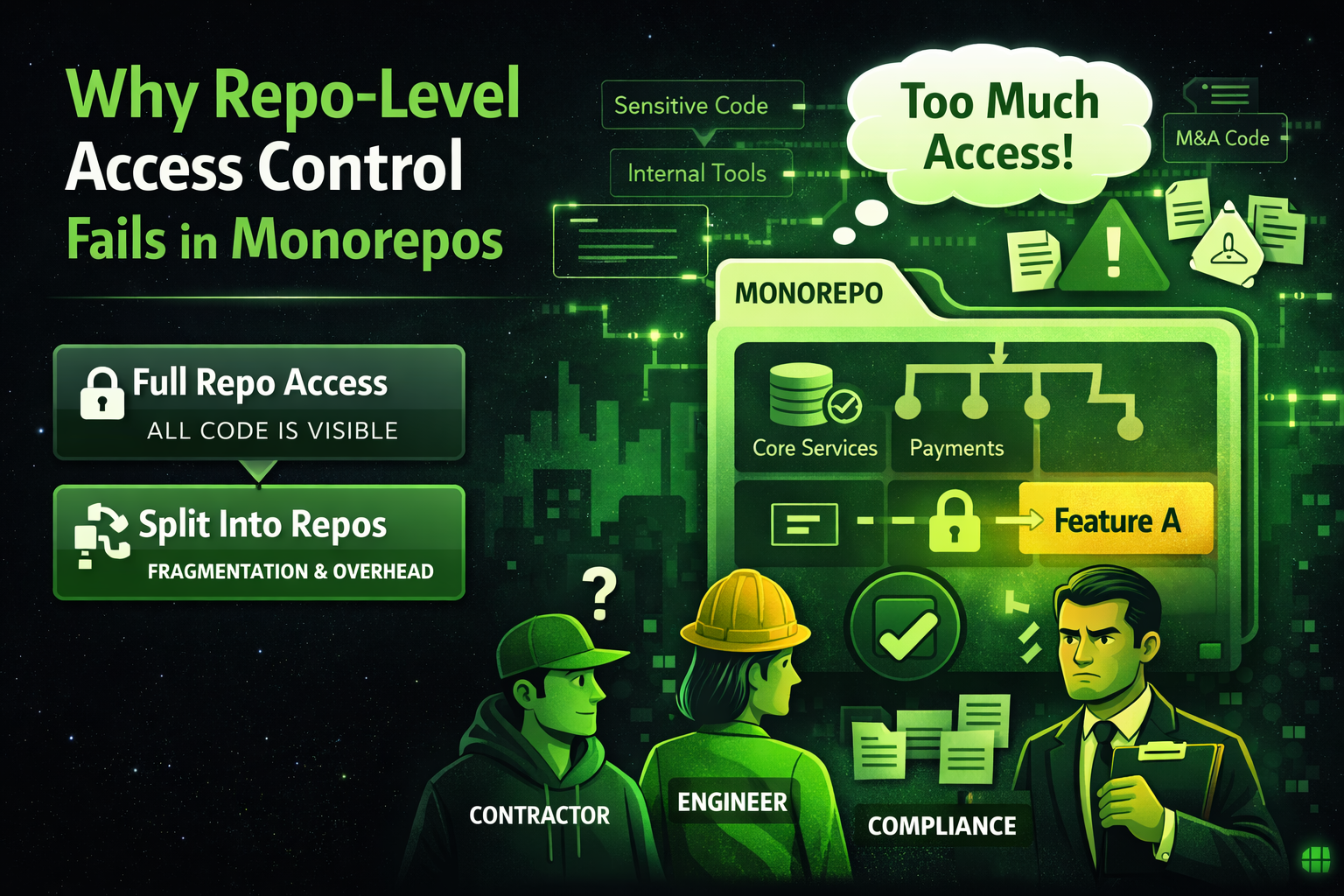
Modern engineering teams love monorepos. One repository. Multiple services. Shared libraries. Unified CI. Faster collaboration. But there is a security problem hiding inside this convenience. When your organization scales beyond a small team, repository-level permissions stop being enough. And that is where most companies quietly lose control of their source code exposure.